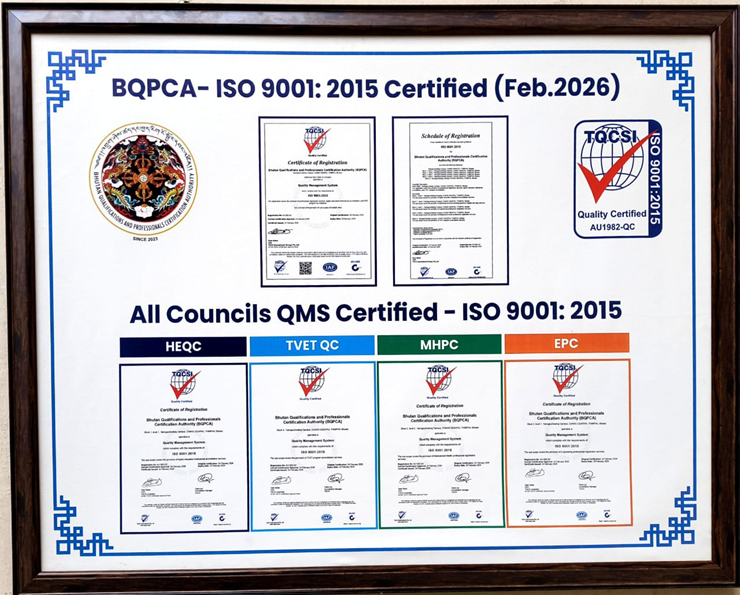


The Bhutan Qualifications and Professionals Certification Authority (BQPCA), Ministry of Education and Skills Development (MoESD), has achieved ISO 9001:2015 certification, a key milestone in enhancing transparency, accountability, and quality in Bhutan’s regulatory systems.
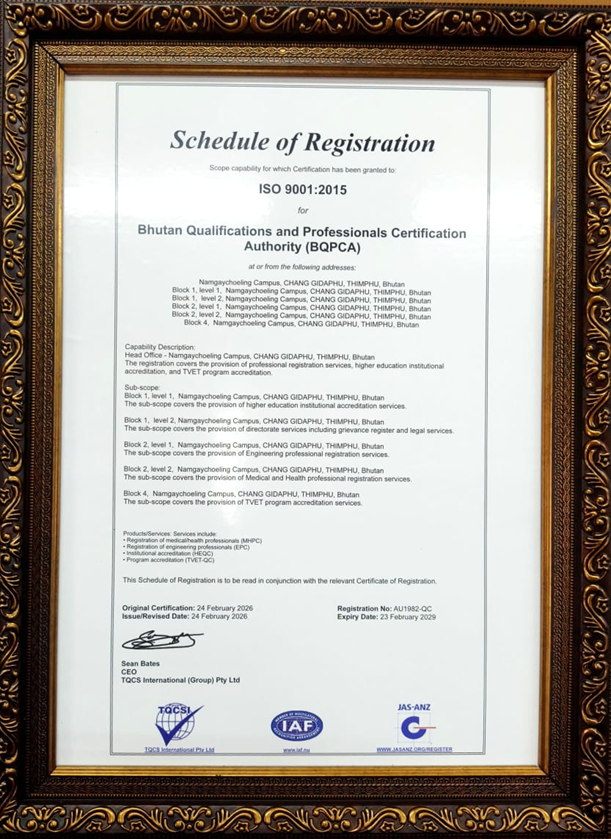
ISO 9001:2015, the global standard for Quality Management Systems, confirms that BQPCA has established structured, consistent, and continuously improving processes aligned with international best practices. Awarded in February 2026, the certification followed independent audits by TQCSI, an Australia-based body accredited by JAS-ANZ.
The certification covers professional registration, institutional and programme accreditation, and governance oversight across BQPCA’s directorate. The Teaching Professional Council (TPC) is expected to achieve ISO 9001:2015 certification within a year or when fully ready.
“ISO 9001:2015 certification demonstrates BQPCA’s commitment to regulatory quality and international recognition, strengthening Bhutan’s qualifications and certification systems,” said Dr. Ugyen Tshewang, Director, BQPCA, MoESD.
With regular audits and recertification, BQPCA ensures transparent, auditable, and high-quality regulatory processes for all learners and professionals.
Frequently Asked Questions (FAQ): ISO 9001:2015 and Its Strategic Importance for BQPCA is given below:
Q1. What is ISO 9001:2015, and why is it important for BQPCA?
ISO 9001:2015 is the international standard for Quality Management Systems (QMS). It provides a structured framework for accountability, risk-based management, and continuous improvement. For BQPCA, it ensures regulatory processes are consistent, auditable, and aligned with global best practices, strengthening institutional credibility, service quality, and public confidence.
Q2. Which BQPCA Councils and services are covered, and how is consistency ensured?
The certification applies to BQPCA’s core functions:
- Professional registration: Medical & Health, Engineering Professional Councils
- Institutional accreditation: Higher Education Quality Council
- Programme accreditation: TVET Quality Council
- Governance and oversight: BQPCA directorate
Consistency is maintained through documented procedures, defined roles, standardized decision-making, systematic record-keeping, internal audits, and management reviews. These measures help each Council fulfill its mandate while upholding harmonized, high-quality regulatory standards.
Q3. How does ISO strengthen credibility and public trust?
ISO certification provides independent validation of BQPCA’s systems. It sets the Authority apart from non-certified regulators and enhances public confidence, international recognition, and operational integrity through transparent and well-monitored processes.
Q4. What is TQCSI’s role, and how long will engagement last?
TQCSI (Australia), accredited by JAS-ANZ, conducted BQPCA’s certification audits. ISO certification follows a three-year cycle—initial audit, annual surveillance, and recertification. TQCSI continues to provide independent verification to ensure the QMS remains effective and compliant.
Q5. Why ISO 9001:2015, and how does it align with BQPCA’s mandate?
ISO 9001:2015 underpins BQPCA’s mission to uphold high-quality standards across Councils, protect public interest, and ensure accountability. The standard emphasizes leadership, risk-based thinking, stakeholder engagement, evidence-based decision-making, and continuous improvement, providing a scalable framework to support future growth and the integration of new Councils, including the Teaching Professional Council (TPC).